WINE ep 2 - Regenerative Wine Growing Builds Better Soil And Wine
===
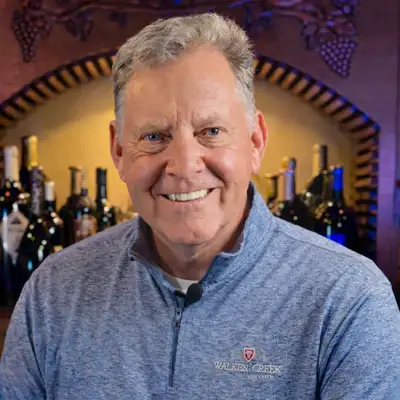
[00:00:32] Mick Wilson: Hello, this is Mick on Wine and the Divine, and I'm, uh, I'm just honored to have Greg Pennyroyal, our vineyard manager at Wilson Creek, with us. And he's done some amazing stuff with our vines and our wines. I'll let him unpack that in a little bit. But right now, Greg, before we, we jump in, tell me, tell me what you're drinking.
I've got right here, I've got something fun. I dug this out of my cellar. It's a, uh, Cab Franc from 2013. I remember when we got down to a few cases of this, we sold it for 100 bucks a bottle. So I Coravin'd it with this bad boy right here, and it's tasting really good. I'm surprised for a 13-year-old wine.
It's got nice acidity, tannin. It's not flattened.
[00:01:19] Greg Pennyroyal: So connecting the Cab to the divine, that is the block we call the Cab Franc block Vines From Hell. That is on a north-facing slope that's probably 45 degrees. And when you work on it, you have to drop the crew off at the top of the hill, and they literally just skid their way down, and then we hop in an ATV and go back.
But that northern exposure, so that, that's, th- that's the one on Di Portola. You probably know that vineyard. Yeah. It's an
[00:01:50] Mick Wilson: tell me, what are, what are you drinking?
[00:01:52] Greg Pennyroyal: So I am drinking Block Nine Cabernet Sauvignon, very appropriately from the Regen Ag project at Wilson Creek Winery
[00:02:01] Mick Wilson: And for those who are wondering what regen ag is, we'll get into that, regenerative agriculture. Uh, that's why I have Greg on here. I wanna drill down into that because it's absolutely fascinating. Um, Greg, before we start, tell us about you, your background, what you did, what you're doing now, and just what, what are your passions?
What, what makes you come alive? Let me, let me just have you run with that
[00:02:24] Greg Pennyroyal: So I originally got-- and so I have an interesting background of, of kind of botanicals and agriculture. My mom was a traditionally trained herbalist from Norway, and she was taught by Helga the Witch, who during World War II, that that was, you know, that's-- they were the medicinal people. You know, they were the people that took care of folks.
And in our particular valley, the Germans allowed my mom and Helga to take care of both German and any civilians, obviously not Allied soldiers, but, you know, there's sort of neutrality in medical, you know, during the war. Uh, my mom came to the States, uh, when I was, uh, 16 years old. We moved to the Catskills in New York and bought a 14-acre farm and started farming that.
And before that, I was in a disco band with my brother by the name of Lady's Choice. Those were the days. And, um, we show up, a couple of city kids, we didn't have a clue. And Hiram Wilbur, the local dairy farmer who was retired, he retired at 96 years old, and he was bored, and he came up and said, "You boys don't know what the heck you're doing, do you?"
So he took me on as a mentor, and that's where I learned farming. Uh, from there, I went on to college. I studied, um, ecology and, uh, organic agriculture, which really wasn't a set study. I had to just sort of put things together. But I eventually wind up going into a field called medicinal plant biogenetics, and what that means is plants express biochemically and then hence genomically very differently depending on what the microbiome, the climate...
What we in wine would call terroir is in medicine, right? It, it translates in, except there you actually see medical effects. Um, for 10 years, I managed Trout Lake Farms, the world's largest organic herb farm. We were just under, uh, 2,000 acres, which for an herb farm is really big. Uh, learned a lot there with Juan Johnson and then got an interesting opportunity to work at Liner, which was a division of Pfizer in their natural products division.
And we started standardizing natural products like echinacea, valerian, you know, a lot of herbs, but you know, some vitamins in there, but mostly herbs. The advantage of that is I had this unbelievable research budget. So we took thousands of samples from around the world, like every echinacea sample I could get, every valerian sample I could get, broke them down biochemically, and ran bioassays on them for their efficacy.
And the part that was interesting is almost to a sample, those that were done in a biological manner, organic, biodynamic, you know, where they're really paying attention, had higher efficacy.
[00:05:13] Mick Wilson: Mm-hmm.
[00:05:13] Greg Pennyroyal: And you couldn't necessarily see it in the amounts of, quote-unquote, "marker compounds," but what you could see it in is in the balance of the biochemistry, which is what created that physiological reaction.
We published some papers, and the most interesting comment I got was from winemakers who were not supposed to be reading genomics journals. And I asked them, first of all, I asked them, "Why are you guys reading genomics journals?" And they're like, "We're winemakers. We, you read everything." But if you think about it, the two people that are most interested in balance of biochemistry are medicinal producers and wine producers,
[00:05:55] Mick Wilson: Mm-hmm.
[00:05:55] Greg Pennyroyal: which brings us to this whole thing that this stuff is actually medicine in a lot of ways.
I mean, that whole thing of having balance and working with your microbiome. And then, as you know, when I got to meet you and your brother, I, um, studied with Peter Pool, a local, uh, viticulturalist, just sort of for the fun of it. I actually came to Temecula to work with my friend and colleague, Lobsang Dhondup, who is a physician for the Dalai Lama in exile in Temecula.
And, uh, I wound up coming to Wilson Creek, having a glass of Et- of wine with Etienne, your winemaker at the time, and, uh, the rest is history. You guys needed a vineyard manager. I said, "As long as you, um, don't ever use glyphosate again and chain up the disc, I'm good."
[00:06:43] Mick Wilson: We'll, we'll, we'll get into why on that, 'cause that, that's key. Well, e- explain also what else you do other than, uh, vine- vineyard manager, the small growers, teaching, things like that
[00:06:54] Greg Pennyroyal: So regenerative agriculture is kind of a unique agricultural approach because there's no set pattern. You know, organic tells you what you shouldn't do. Biodynamic is a very set process based on the work of Rudolf Steiner. Regenerative ag basically tells you that anything you do that increases the complexity, density, and self-regulation of the ecosystem is a go, which means it's very cutting edge, and there's a reason why we call it research.
If we knew what we were doing, we wouldn't call it research. So there's a lot of us collaborating all the time, and because we-- it's so interactive and so community-oriented, we always feel obligated to kind of reach out a lot. So to that end, um, I teach at Mount San Jacinto College. I teach viticulture with a very heavy emphasis on regen ag.
I occasionally do regen ag mini seminars there. Um, I'm the founder of the Small Winegrowers Association. Um, we realized that almost 30... about 35, 40% of the valley's production are with people that have under five acres. Most of them are only an acre or two. And so they have all the problems that we have, they have all the issues that we have with no support.
So we get together once a month, we do an educational seminar, and then sometimes we just sit on the stage and take questions and answers. Uh, we currently have 380 members. So that's Riverside, you know, all the way down to San Diego, all the way up to Rancho Cucamonga, so that's been a great project.
Another project that just is kind of... Actually, I was just there a couple of hours ago, meeting with a new cohort of students. The Temecula Valley High School, six, eh, maybe it's four years ago, maybe five years ago now, a bunch of students watched the movie "Kiss the Ground,"
[00:08:49] Mick Wilson: A great movie
[00:08:50] Greg Pennyroyal: which, by the way, yeah, I'd recommend.
They were so inspired, they went to the administration and asked if they could start an after-class school, of which they did. They found one of my students, Megan Mannion, who teaches at the school, and, um, they asked if I would be an advisor. Six years later, we have four acres planted behind the school.
They have a one-acre vineyard, they have olive trees, they have stone fruits, and the students are up there doing amazing work. Um, not only are these students inspiring, but it's remarkable, almost every one of them has gotten into Berkeley, Stanford, Harvard. I mean, it's just... I was joking with them at the last commencement saying, "I am really proud of you guys.
I sent an application into Berkeley, and they decided I should go to Prescott instead."
[00:09:41] Mick Wilson: Oh, yeah. a notch up there, yeah.
[00:09:47] Greg Pennyroyal: Yeah. So a lot of it's just about community. You know, we have a really strong... And, you know, Wilson Creek is a great home for that because, you know, this place is so infused with Jerry Wilson's community vibe.
[00:09:59] Mick Wilson: Yeah, that's my dad. Yeah, for those wondering. Yeah
[00:10:03] Greg Pennyroyal: Yeah. For those of you who didn't get to meet Jerry, uh, I'm sorry. I mean, he was just an amazing force of nature, and his hospitality was so genuine.
[00:10:12] Mick Wilson: Yep
[00:10:13] Greg Pennyroyal: Um, you know, Jerry was the one that in another business, I would get chastised for disappearing for two hours to go help the students. But here it is, it was not enough time for the students. Did you, did you get your work done with the students? It's just a very different vibe of we're part of a community
[00:10:32] Mick Wilson: Yep. And we're working with, uh, UC Riverside, and I see a lot of,
[00:10:37] Greg Pennyroyal: Mm-hmm.
[00:10:38] Mick Wilson: lot of other agencies on our property checking out what we're doing, which is kind of fun learning from each other. I love that
[00:10:45] Greg Pennyroyal: Yeah, because we're kind of cutting edge, th- there's a lot of the, the USDA Soil Salinity Lab, we were their first regen ag project. I have been working with UCSD, um, on some mealybug projects, and we-- Kathleen Dowling, also one of my students, who is also one of my employees, or I should say one of our employees, is now working on her doctorate degree at UC Riverside, University of California Riverside, where they are opening up a dedicated regen ag lab.
That's great. And we're... Yeah, and we are starting by doing a couple of projects here in Temecula
[00:11:23] Mick Wilson: Okay, so for the listeners, we, we, we say the word regenerative. To put it in context, compare and contrast that to conventional, to, uh, sustainable, organic, biodynamic. Uh, what do those all mean, and where does regen then take us from those?
[00:11:40] Greg Pennyroyal: So let's start with quote unquote conventional, which it's kind of odd that we call it conventional because we've only been doing it since World War II. But post-World War II industrial era agriculture had a basic philosophy that we know better than nature, and that we need to take over and intervene, and if you have an insect in the vine, it's...
You have to kill it. If you have powdery mildew, you have to kill it. If you-- It's pretty much an antibiotic view of life, of that we try to make things sterile, we try to simplify things. But most importantly, the mindset is that we know better than God. I mean, we know better than the creation, and we intervene.
Organic was a sort of reaction to, especially a lot of the really strong chemical, um, issues that happened in the environment and public health like DDT almost wiping out our national bird and, and a lot of others. Um, paraquat, um, Parkinson's disease coming from glyphosate, which is Roundup, and all these health issues came up.
So basically what organic said is you just can't use those harmful chemicals. But it still sort of had a philosophy of if you have an insect, you kill it with an extract of clove, or you do something that's a milder chemistry, but you're still trying to kill the pest
[00:13:07] Mick Wilson: So organic is what you can't use?
[00:13:10] Greg Pennyroyal: Exactly. Organic pretty much tells you what you sh- can't do, but it tells you almost nothing about what you should be doing.
[00:13:17] Mick Wilson: Okay
[00:13:19] Greg Pennyroyal: Biodynamic is this interesting hybrid. Um, Rudolf Steiner was a metaphysical, uh, philosopher and researcher. He was the founder of the Montessori school system.
he wrote a book called The Treatise on Agriculture that basically says nature isn't a biochemical universe, it is a electromagnetic one, and that by using things like biodynamic preparations, it's not that the cow poop and the horn buried on the solstice facing a certain direction, it, it's, in itself, it's meant to be like an antenna for earth energies, which may sound pretty woo-woo, and I have to admit, the first time I read the book, I thought it was kind of woo-woo, and I was a little like, "Yeah, I don't know about this guy."
[00:14:05] Mick Wilson: to, to, to back up, uh, people are wanting cow poop, horns. Uh, eh, just, uh, just go with, go 20 seconds on that
[00:14:12] Greg Pennyroyal: explain this a little. So there's something called biodynamic preparations, and what they do is Steiner said that certain elements have a certain energetic property, and if you focus that energetic property, you can then expand it in mediums like water. So it is almost identical to the basic theory of homeopathy.
So when I was at Pfizer, we actually studied homeopathic Arnica. And here's what's interesting about this. So I'm, I'm gonna draw a correlation between homeopathy and, and biodynamics because it's kind of an interesting theory on energetics. If you take a one X extract, this is basically a one X extract of grapes, right?
And put one part in nine parts of water, that's a 10% dilution, it's a two X. If you take that and take 10%, that's a three X. You keep diluting it and percussing it. The theory is, is that the electromagnetic pattern, which all compounds have, gets replicated in the water and increased even though the actual chemical component is decreased.
We ran that on some tests with genes. And so gene assay testing is you get a bunch of white blood cells and you put the medicine in it, and you look at how the genes up and down regulate. That's how they communicate. And you can tell the efficacy of a drug using gene expression. It's a standard drug technique.
We did that with homeopathic preparations. Now, if you do that dilution 24 times, you pass something called Avogadro's numbers, the point where theoretically there's not a single molecule of the original material left and we were getting higher efficacies at 30X than we were at 1X. Explain that, right? So what that really opened my eyes to is there are levels of functioning in science and in nature that we just really don't understand.
We are starting to understand that the new field of this is quantum chemistry. That's what quantum chemistry understands. So back to Steiner. Steiner somehow had an insight to this back in the late 1800s. And so what they do with these preparations, so for example, it's BD26, I think. You take a certain kind of cow manure, you pack it in a cow horn, which is supposedly like an antenna.
It's, the cuticle structure is like an antenna. You bury it at a certain time of year, and the cow manure gets charged with this energy, and then you can put it in water and irrigate with it, and it has this positive effect on the electromagnetic forces of the vineyard
[00:16:59] Mick Wilson: Yeah. I, I, I, I visited a biodynamic vineyard up in Sonoma, and they, uh, had a, a sprayer. They sprayed it on the leaves, which is interesting
[00:17:09] Greg Pennyroyal: Yeah, and it has an effect. What that effect is, I don't know
[00:17:16] Mick Wilson: I'll tell you this, the wine tasted good. I don't know about the cow horns, but the result was pretty impressive. So biodynamic also does a lunar calendar. Just, uh, explain that a little bit
[00:17:27] Greg Pennyroyal: The biodynamic philosophy says that there are energetic forces that flow through the universe that we sort of just are floating through as we're on a planet circulating. And we all know that's true. There's gamma rays, there's all sorts of forces that, you know, dark matter, that we're just starting to discover.
The moon has a very specific relationship to that because not only is it reflecting energy back to Earth, but it has, A, it has a gravitational pull on the Earth, but you always know which direction the planet's facing by the phase of the moon. The phase of the moon matches which direction the planet's facing, so that will influence what direction certain cosmic forces behave your planet.
And this is accepted modern physics. They just don't always agree that it helps with plant growth and all that. But when I have people say, "How can the moon possibly affect the germination of plants?" I just say, "Go to the beach and watch how it affects the, the, the depth of water." I mean, there's an influence there.
[00:18:33] Mick Wilson: Yeah
[00:18:34] Greg Pennyroyal: Once again, exactly what that is, I don't know. But, you know, one of the things I've learned on this path is I know a small fraction of things that are probably true, and most of what's going on in the world, I just don't know, and I'm just really comfortable with that
[00:18:51] Mick Wilson: Yeah. It just e- exactly. You get into quantum entanglement and stuff like that, it just... You're at a point where you go, "Ah, I don't know. I don't know." Hey, hey, um, so now let's jump to regenerative because some of the listeners will probably see that in wine shops. They'll see a regenerative section, or they'll see it on a label, or they'll see it on a show.
What's the difference between that and biodynamic and organic?
[00:19:18] Greg Pennyroyal: Regenerative doesn't have a specific definition, and those of us in the field are pushing hard to keep it that way. With organic, what wound up happening is when I first got into organic farming at Trout Lake Farm 30 years ago, there was one agency, it was the Oregon Tilth organic organization, and you can tell by the name what they were concerned about is soil health, hence the name Tilth.
That became the first government-sponsored organic certification, which was Washington State Organic Certification, which got watered down a little bit. Then Washington State went to Washington, D.C., and it became a federal program. And Kraft and, you know, um, Sunkist and all the big corporations showed up for that and kept watering it down and watering it down until it's the point now it's just a list of what you can't use.
We didn't want that to happen to regenerative. So with regenerative, it's, it's... There's a, a philosophical background to it, and the basic background is nature already has everything it needs. Nature is already balanced with what it needs. When you see an insect attacking your plant, that's nature's garbage disposal team showing up to get rid of a plant that's not ideally matched to that particular ecosystem, so another plant that is better matched can take its place, develop that ecological niche to the point where maybe that first plant can then survive.
So the difference with that is it is a pro-life. It is saying if you keep enhancing life forces, there's some competition, but it's actually mostly cooperation. You know, by the way, the term survival of the fittest did not come from Darwin.
[00:21:12] Mick Wilson: Nope. Yep
[00:21:13] Greg Pennyroyal: That came from an economist. Darwin talked about survival of the cooperators.
Um, that's most markedly if any of your listeners want to see a TED Talk that'll blow their minds, I think it's Susan Stenard, the woman who did the research on how birch and aspen communicate
[00:21:35] Mick Wilson: told me about that and I saw it. And for those listeners, just look it up. It's, what, 15 minutes, but it's mind-blowing the research he did. And that's... Are you referring to the mycorrhizal network? Yeah. Yeah
[00:21:47] Greg Pennyroyal: Yeah. Yeah. But so that's, that's kind of the essence of regenerative agriculture. What it says is nature has this naturally complex, self-regulating, balanced system, and anything you can do to increase that diversity, density, and self-regulation is moving you towards regenerative. So, for example, this year I was able to get a lot of compost that was a little bit lacking in nitrogen.
So I took some synthetic nitrogen, it's called urea, I mixed it with humic acid, which is a natural cum, I chelated it, I spread it into the compost, turned it and let the bacteria turn it into organic compost, and then spread it. And the, the microbiome loved it. It said, "This is food. This is great. This is what we want."
Organic wouldn't allow me to do that because the urea is technically synthetic, but I turned it into something that's not synthetic. So if you were to sum up regenerative, it's about regenerating life. It's a pro-life, pro... That life regulates itself
[00:22:58] Mick Wilson: It's a regenesis.
[00:22:59] Greg Pennyroyal: It's a read genesis, yeah
[00:23:01] Mick Wilson: Yeah. So tell me, when you, came on t- uh, 2015, and when did you start the regenerative approach in our vines with our, with our experimental block, and what have you done? And then to add on that, what have you seen as the results, not just in the grape quality, but the soil and the life?
[00:23:23] Greg Pennyroyal: So the first couple years were much more practical. I mean, the, the problem with... When I got here, we used to disc three to four times a year and spray herbicide
[00:23:35] Mick Wilson: be- because we thought cleaner is better. If it looks clean, looks good, get rid of the weeds, disc more. That, I, that's what I thought, and then all of a sudden I met you and we start talking about tilling is bad. It's like, wait a minute. So yeah,
[00:23:49] Greg Pennyroyal: Yeah. At,
[00:23:49] Mick Wilson: we bounced off of that, right?
[00:23:51] Greg Pennyroyal: at a certain point we'll tell the gopher battle story,
[00:23:54] Mick Wilson: Oh gosh. Okay.
Yeah
[00:23:56] Greg Pennyroyal: But you're right, and part of that is just a perception thing. So now when I see a field that's distant empty, it looks ugly to me. It looks dead. It looks barren.
[00:24:06] Mick Wilson: It's inert. Mm-hmm
[00:24:07] Greg Pennyroyal: a dirt. And when I see one that's full of, of quote unquote weeds, we don't call them weeds anymore, they're medicinal indicator species.
Because you can literally walk-
[00:24:16] Mick Wilson: a minute. I'm, I, I have to go pull some medicinal...
[00:24:20] Greg Pennyroyal: In this planter species.
[00:24:22] Mick Wilson: Oh my gosh. Okay, I
[00:24:23] Greg Pennyroyal: So here's what-- weeds are nature's forgiveness. Weeds are nature's way of saying, "You've disrupted this system, so I'm gonna put a plant that's well-adapted to that disrupted environment to eventually get it to a more complex environment." What we call, the species we call weeds, especially things like foxtails, are from compacted soils that have lack of calcium availability and limited nitrogen, and there's a bunch ex-excess magnesium, you know, excess salts.
But rather than just let it be barren, it will find a species that fits. The challenge with nature is nature has no problem with taking centuries and centuries to fix something. We don't have that kind of patience. So every year I go out with my high school students, and we have one square meter, um, uh, pipe squares, and we drop it, and we do an inventory of all the indicator species.
Then we take 100 steps and do it again. We take 100 steps and do it again. And we map all that. We put it in an Excel spreadsheet and see what ratio of what plants are out there. And then there's some really interesting books, like one's called, um, Why Weeds Grow. And we look up that weed, and it'll tell you excessive compaction, lack of calcium.
It'll tell you... And we look for the commonalities. And then when I do a cover crop, I look for what the next species would be in that evolutionary cycle for the cover crop. In other words, what's gonna take advantage of what the foxtail did, but then take it to the next level so it's not optimized for foxtail
[00:25:56] Mick Wilson: Yeah, so you match the cover crop to what, to what the soil needs in- in- indicated by what the weed is telling you
[00:26:03] Greg Pennyroyal: Hence, indicator medicinal species. They're literally there fixing the, the, the soil and they are talking to you. They're trying to tell you something. They're saying, "I can't breathe. I'm gonna give you foxtails." If, if you wanna motivate someone to change an ecosystem, grow a stand of foxtails.
[00:26:23] Mick Wilson: Now, now I, I, I, I recall we had a conversation. I was walking in the vines one time, and to our, to my left was a neighbor vineyard, and then I just tilled clean. You could see all the, all the till marks in the soil, not a weed. I looked at ours, and it's messy chaos. You got dandelions, you got all kinds of plants growing up the trunk.
Uh, you couldn't see any dirt. It was just alive with I f- don't know how many different plants, and I talked with you about that. I said, "Greg, you know, our, our vines are messy." And you said something, and kind of riff on this a little bit. You said, "Messy is good."
[00:27:00] Greg Pennyroyal: Messy is good.
[00:27:01] Mick Wilson: yeah, why?
[00:27:02] Greg Pennyroyal: Well, so that shows diversity, right? I mean, so let's draw an analogy to culture. If you live in an area that has all of the same cultural background, same people, same whatever, there's a couple things that can happen. One, if a disease ever breaks out, the sickness is gonna spread like crazy because everyone's genetically identical.
The other thing is just from creativity in the community, you're not gonna have that exposure to that really interesting Irish, you know, fiddle-playing neighbor versus the other guy who's a classical pianist and the other person who sings and, you know, that's what makes creativity, is diversity. The same thing is true in an ecosystem.
The more diversity you have, the more each plant can then help each other. This is what Simard talked about in that, um, that TED lecture and her book called The Mo- I think it's called The Mother Tree, if I'm not mistaken. Um, but anyway, she talks about if you have a spruce and an aspen, the spruce is photosynthesizing in the winter when there's plenty of rain and plenty of sunshine, and the aspen has no leaves.
So the spruce will feed the aspen all winter. So when the aspen actually does send out leaves, large leaves are way more efficient photo, uh, you know, photonic collectors, light collectors than a spruce is. The spruce then pays back the aspen. They're in a mutually symbiotic relationship. The same is true with the weeds in the vineyard.
The more you have, the more diversity. The other thing is what we've just learned in about the last 15 years. When I went to ag school, I was taught that the way nutrients got into plants is they had to be in a water-soluble form, and then through osmosis they would go through the roots. You know, it's higher, you know, density to the lower density, which doesn't make any sense on any level, but that's what we were taught.
There's now something called rhizophagy,
[00:29:04] Mick Wilson: Mm-hmm.
[00:29:05] Greg Pennyroyal: it actually says the number of cells inside a plant is greater than the number of cells of the plant. In other words, by number, the majority of living things inside the plant are not plants. They are bacteria, they are fungi. They're called endophytic. They go into the plant, they get stripped of the nutrients and sent back out.
But when they're sent back out, they give nutrients to the plant, which then turns sunlight into sugar. That sugar then goes back out to the roots. So when the bacteria and the fungi are set is they're given sugar, which is energy. Their fuel tanks are filled up. They can go out and get nutrients and then come back to the plant, drain their nutrients into the plant, and the cycle keeps going
[00:29:51] Mick Wilson: Now, now that, that tripped me out when you first exposed me to that, that, you know, the term mycorrhizal network is this whole underground fungal network that, it's amazing how many filaments... Maybe you can talk a little bit about that, about, about what goes... Uh, e- e- health above the ground means health below the ground, from what I understand and what I'm learning, and that if you have healthy diversity above the ground, it'll create life under the ground.
So talk a little bit about the mycorrhizal network and how many... you mentioned a stat of a handful of healthy soil. One time I used the word dirt with you, you said, "It's not dirt, it's soil." Corrected, yes. And in, and in, in a footprint on healthy soil, how many f- how many miles of filaments are in there?
[00:30:39] Greg Pennyroyal: So in a teaspoon of healthy soil, there can be well over a mile of mycorrhizal fungi. In a teaspoon.
[00:30:49] Mick Wilson: That's...
[00:30:50] Greg Pennyroyal: I don't even know how that fits, but somehow it fits. And now that's a pretty advanced soil, um, generally what you'd find in a forest. However, there are agricultural systems that can do that. And the thing with grapevines is it's a perennial system, so there's no reason why we can't start to strive towards that.
the other thing that's interesting about fungal networks is they work in a node system, which means that it's not just like a giant strand of spaghetti. They have connections, and they're aware of where the connections are. And so the nodal branching of mycorrhizal is mathematically almost identical to the nodal branching of your, your neurons and, neurological pathways.
It uses the same basic structure and same basic mathematics.
[00:31:41] Mick Wilson: Crazy.
[00:31:42] Greg Pennyroyal: It's also aware of where it is. There's this interesting series of experiments where these mycologists, those are people who study fungi, took a tray. They made a map of Tokyo and put oats in proportion to where the population was, and let the fungi go out and find the oats and develop main pathways.
And they matched the main pathway to what engineers identified of what the most efficient transport system was. And the fungi not only identified all of those best corridors, but there was some linkages that the engineers never thought of that they later went back and said, "Oh, yeah, that makes sense."
The fungi literally designed the Tokyo subway system better than the engineers could.
[00:32:30] Mick Wilson: It, it's crazy. So, so back in a big picture, and we've had some rich discussions over some good read about this, when you look at all this interconnectingness, this whole system, and we talked about the divine, of sense of being, of some type of energy holding all this together, what, what comes into your mind?
[00:32:51] Greg Pennyroyal: So I don't know of a single natural sciences biologist that isn't absolutely in awe of nature. Now, what they call that varies. You know, you could call-- look at it from a Christian perspective, from a Buddhist perspective, from a whatever. But it's that recognition that it is a system that has an intelligence that's beyond what we recognize as intelligence.
Now, it doesn't, you know, the-- I, I think the challenge for a lot of people is there is a, um, there's a shift in perspective when you see how these systems kind of self-regulate and how they build on each other. It's in science what we call a paradigm shift,
[00:33:42] Mick Wilson: Mm-hmm.
[00:33:42] Greg Pennyroyal: where you have a fundamental understanding of the world that's different.
And what's different about the natural sciences is you realize is that there is something that inf- uses that system with intelligence. And that doesn't necessarily mean it is a thing. It can be a collection of things. I mean, this is what's so interesting about the fungi. There is no master fungi in that fungi looking for the oats, making a map of the Tokyo subway system.
Somehow the whole thing communicates in a way that creates an intelligence. I mean, it's just... There, there was a recent article about the, um, mathematics of bird flight. Um, there's a word for that, and I forget what it is off the top of my head. But people for years couldn't figure out why birds don't bump into each other.
And then an animator for, I believe it was Disney, was trying to create a algorithm to teach a computer how to have animated birds
[00:34:45] Mick Wilson: Oh, are you, you're talking about those big swarms with thousands of birds that move almost as one unit.
[00:34:51] Greg Pennyroyal: with sardines and all that. And so a computer programmer figured out if you have a simple formula that says if you are heading in a direction, all you need to know is what the person next to you doing and the person next to them, and that's it. And if that just keeps replicating, you get these swarms.
And there's enough leadership in the swarm that if someone sees a food source or a good place to roost, they will head there. But that's why it's kind of they're all over the place first, and then they head there because the intelligence of that swarm needs to catch up with itself, but it does. So that's the inspiration.
And the more we sort of peel back the onion, there's just one layer... There's this great concept called quorum sensing that was, um, really developed by a scientist by the name of Christine Jones out of Australia. And she is the one that figured out that until your soil biology develops a certain quorum of beings that can then communicate, the communication system doesn't function.
You need that base quorum, which is sort of the basis of philosophy and religion, right? You have to have that quorum of understanding so you're communicating with each other, and then you as a quorum can then communicate with the larger system that helps regulate it
[00:36:16] Mick Wilson: And, and is that why you've been pushing in our vineyards the diversity? Uh, is that kind of on that same line that if you take out certain elements, you hurt that whole interconnectedness, right? I remember you, you mentioned gophers real quick. I despise them. I'm the Bill Murray of the winery, and I was up at a vineyard, um, the biodynamic one in Northern California, and I saw gopher holes everywhere in their vines.
I was like, "Get rid of these bastards. What do you guys do with them?" And they said, "Well, we like them in moderation." Well, I came down and talked with you thinking you would side with me, "Yeah, let's get rid of these guys." You said, "No, they are very good in moderation."
[00:36:51] Greg Pennyroyal: in moderation
[00:36:52] Mick Wilson: Yeah, and I'm thinking, "Wait, wait a minute."
And, and that's where the, the, the other movie you turned me on to, the, the, The Biggest Little Farm,
[00:37:00] Greg Pennyroyal: Yep,
[00:37:00] Mick Wilson: where if you take out one element, that it affects all that interconnectedness, and if you take out gophers and then you don't have the tillage, and you talked about gophers are what? God's rototillers. And so what I tried to get rid of, you're saying in moderation, of course,
[00:37:16] Greg Pennyroyal: The moderation.
[00:37:17] Mick Wilson: small plants, they can
They, they're not good. Flower beds are not good. They need to go. But overall, is that kind of quorum theory where everything works interconnectedly?
[00:37:29] Greg Pennyroyal: Yes, because if you have a healthy microbiome, you will have a certain number of gophers. if the medicinal plant species are feeding your vines and the vines have healthy, um, um, root structures, the vines will make themselves unappealing to the gophers and the gophers will eat your cover crop.
No loss, right? It's no problem. Once the gopher population reaches a certain point, my owl boxes, instead of having one successful fledge, will have four, 'cause there's so many gophers. Until the gopher population starts to drop down and then the
[00:38:03] Mick Wilson: balances itself, yeah
[00:38:05] Greg Pennyroyal: population starts to drop down. It, it, it starts to regulate itself.
I also remember sending you a, one of the funniest articles I've ever seen, which was a study of Mount St. Helens,
[00:38:15] Mick Wilson: talk
[00:38:15] Greg Pennyroyal: right after that right after the eruption, they get this one square meter cage and they drop a gopher in for one day. And what I loved about it is it shows the gopher on this barren moonscape, and it says, "Gopher in Mount St.
Helens," blah, blah, blah. And then it said in parentheses, "Very unhappy gopher." It closed parentheses. And they came back 10 years later, and from an aerial photograph, you can see that one square meter grid. It is green and flourishing, and everything else around it is just getting caught up. So what we've since learned, after reading that article, I went out and cut into a couple of gopher pathways and sliced the dirt, so I had a cross-section of the dirt.
And I looked at the microscope right on the edge of the gopher hole versus an inch or so in. The edge was teeming with microbes,
[00:39:14] Mick Wilson: They're farming
[00:39:15] Greg Pennyroyal: the outside was... Yeah, they're sweaty, stinky, you know, slimy. They're, they're gophers. They're, they're not the cleanest animals in the world. But that's another... Here we are judging them, right?
They're not clean. They are little microbiome transporters. I mean, we don't say the bees are dirty because they have pollen all over them. We say they're pollinators. Well, these are, like, I would call them gophinators, but we know what a gophinator is. For everyone who doesn't, a gophinator is a tool to get rid of gophers where you fill the hole with 50% propane, 50%
[00:39:48] Mick Wilson: Oh yeah. It's called, it's also called a varmint getter, a Rodenator. Uh, we used to have one of those, but you said, "No, it, it hurts, hurts the roots and, and there's... No, we need those gophers." Like, oh, that's so fun blowing those
[00:40:00] Greg Pennyroyal: It was fun. It was fun. The other reason to get rid of it is gophers were,
[00:40:05] Mick Wilson: for those wondering, you, you, you take a container of O2 and of propane, you have this wand, and you put the wand into the tunnel system.
You release those two gases in there, you stand back about 20 feet, put a face shield on, ear, ear protection, say, "Fire in the hole," and the entire tunnel system just explodes, and it sounds like a shotgun. So much fun, but you came in after we were having too much fun and you said, "No, that's not good for the root system.
It's not good for the very delicate ends of the roots." It's like, "Ah, yeah, he's right."
[00:40:36] Greg Pennyroyal: another reason I pulled that. So in empty lots and stuff, they're fine, but gophers bring the grass down to make their nests and to store food, and it is a fire. And on block eight, our Sarai went out one night as the wind was blowing and sparks were coming out of a gopher hole that we had just blown up because it ignited the grass.
[00:40:58] Mick Wilson: Yeah, that, that's
[00:40:59] Greg Pennyroyal: unless it's really wet, they're kind of dangerous
[00:41:02] Mick Wilson: So what is it that you right now are doing that you're finding in regen and just in your work in general at Wilson Creek that you're just making... It's making you come alive. You're like, "This is fascinating." What are you excited about right now?
[00:41:17] Greg Pennyroyal: I am ex-- really excited about the emergence of some of the technology coupled with more of a wider understanding of this sort of grace of nature. Like, instead of us trying to figure out nature, we are becoming students of nature, like really learning how to observe. A couple of tools that are just amazing.
First of all, believe it or not, is AI. I use, you know, artificial intelligence a lot 'cause we get a lot of data, and I can say, "Look through five years of data and look for trends of whatever, whatever." The other thing is the technology is getting so good. I just had a, a research meeting this morning. Um, we are looking at a handheld meter that you'll be able to clip on a leaf and then get a complete assay of the plant sap.
It's like a blood sample analysis. I currently do that, but I have to pick two hundred leaves, pack them in a vacupack, send them to the Netherlands. The Netherlands runs them through this whole process. I wait a week, I get charged a hundred and fifty bucks, and I'm still driving it in my week-old rearview mirror.
This would be on-the-spot s- plant sap analysis, which would give us incredible insight. What I think I'm most excited about is if you can do genomic profiling. In other words, we look at the chemical composition of certain genes. when I first got into genetics, a single genetic test cost anywhere from twenty-five to fifty thousand dollars.
[00:42:51] Mick Wilson: Jeez
[00:42:52] Greg Pennyroyal: It's now about twenty-five cents. Um, and we can look at the... Instead of just looking at one set of genes, we can look at thousands of them at the same time. So what we can do is take a look at the phyllosphere, the leaf, or the carposphere, the fruit, or the rhizosphere, the roots, and get a genetic profile.
And what the different families tell us is who's there. And if you know who's there, you kinda know what the environment is like and what your diversity and, um, density is like. So it is an amazing time to be in science.
[00:43:27] Mick Wilson: Yeah. And it's, and it's, and it's going faster and faster.
[00:43:31] Greg Pennyroyal: It's going
[00:43:31] Mick Wilson: Yeah. and kinda what you're saying is, is what we're, we're discovering what's already happening in nature, that we're the learners in this. Nature's been doing this for a long time, and we're the ones that are the students, right?
[00:43:46] Greg Pennyroyal: That is a great way to put it. you know, one of the, the books that influenced me remarkably was, it's called "Black Elk Speaks." I believe he was a Dakota, um, elder, but it's an amazingly articulate book about the Native American perspective on being able to observe nature for what it really is.
The other, another book that influenced me very much was, uh, you couldn't get more different, was Ray Dalio, who was the founder of Bridgewater Associates, the most successful hedge fund in history. And what they both have in common is they both talked about this concept of radical reality, of seeing the world for what it really is, not what you think it should be.
[00:44:32] Mick Wilson: Yeah
[00:44:33] Greg Pennyroyal: You just learn how to observe with just going, "Okay, this is what's really going on here."
[00:44:37] Mick Wilson: Now let me, let me ask you this. We've got a few minutes left here. When you observe those things, this is Wine and the Divine. When you observe those things and you watch that interconnectedness we're talking about, you see that mycorrhizal network, you see what nature does, whatever we can call the divine, God, it, a force, uh, what characteristics of that being would you say that this nature, this, the, the...
What we're observing would indicate that that force is like?
[00:45:12] Greg Pennyroyal: So what makes something divine for me is the idea, first of all, that it's kind of self-regulating, but that it's also replicating and looking for higher levels of density and diversity. So nature is always looking to constantly reinvent itself. I mean, from a bacteriological perspective, nature reinvents itself every six minutes.
And then from an ecological perspective, it's every season. And then from a climatic perspective, it's every 12,000 years. And there's just all these amazing cycles and cycles and cycles built. To me, that's indication of what I would call divine. That is that whole concept of you see how the system is aware of itself, but then creating newer, newer levels of itself all the time. I mean, it's what's called, you know, it's evolution, but it doesn't get into the whole political argument of evolution, uh, from a biblical perspective versus a Darwinian perspective. Look, it evolved. I mean, we-- it's obvious things evolved because the... I see it every season. As to, you know, how you actually interpret that is, I think it's kind of not the point.
The point is the system is self-aware and it is changing, and it's always-- It's... And it's not always changing in the same direction. The actual direction it heads, it changes all the time. But it's always going towards more life, more density, more creativity
[00:46:56] Mick Wilson: Yeah. So it's getting more complex, more life, more vigor, so to speak. Um, but, but, but what you're saying, it's, it's not a static entity. It's something that is constantly moving and morphing and changing and expanding.
[00:47:12] Greg Pennyroyal: I gotta tell you something, Fyx. So when I was in the herbal world, I did some work with an herb called damiana. It is a female estrogen precursor. It's also called Mexican wild yam, is the more common name for it. And I was working with almost all female researchers on this. So it was a little odd being the male guys, you know, doing a estrogen research thing.
But we talked about the whole concept of male and female and why nature does that. And when you see those kinds of dichotomies, often nature will take one part of a species or one part of an ecosystem and embed it with incredible complexity and capacity, but it also makes it prone to breakdowns. And then it'll give another side that's kinda simple and stupid, but really robust.
[00:47:54] Mick Wilson: Is that the male side?
[00:47:56] Greg Pennyroyal: Yep. You guessed it. So from a biochemical perspective, it's actually true. Women are amazing. They can create new life, and it's just they have this, uh, you know, sensory smell of what's going on with their babies by smell. I mean, women's neurological systems are markedly more complex than men's,
[00:48:15] Mick Wilson: Well, look at birds. Look at ducks, right? Yeah
[00:48:19] Greg Pennyroyal: but it makes them prone to breakdowns. And I've had this conversation with plenty of women. They all go, "Yeah. Yeah, that happens." So the analogy we used to talk about, it's like women are like Ferraris. Unbelievable performance, but you gotta keep them tuned up. You gotta make sure that, you know, you gotta take care of them.
Men are like three-and-a-half horsepower Briggs & Stratton lawn mowers. They only cut the lawn. It's all they do, but you pull the cord and it starts every time. That's the brilliance of that system, complexity and simplicity. You know, it, it has these different aspects, the yin and the yang that they put together, and if one system starts to fail, the other system is there to support it.
And if this system excels, it pulls the other system along with it
[00:49:03] Mick Wilson: Love it. Well, Greg, we, we're, we're, we're, we're out of time. We gotta do a part two on this because yeah, yeah, this is fascinating, and I wanna dive more into may- maybe just answer this real quickly. How has this affected... We have the Block 9 cab that you're drinking right now. How do you think the whole regen, the regenerative farming, what we're doing, the biodiversity, the cover crops, the messiness, all the life under the soil, what's the fruit of that?
[00:49:31] Greg Pennyroyal: It's making better wine, which is great, but I don't think that's the major impact. As you know, we now have the Regen Ag Tour, which is probably our most popular tour. I think what it's doing is it's showing people that we are gaining a better understanding of radical reality. We're understanding our world better, and that there's hope.
We live in a world that has been defined as polycrisis, one crisis after another, and when they go out in the vineyard and they see that we're figuring this out, and it turns into a great glass of wine, and they're enjoying it, and they have a great time with their friends, they come back from that going, "There's hope.
There's a way out of this."
[00:50:10] Mick Wilson: And, and for those, uh, Greg mentioned this movie, Kiss the Ground, it's narrated by Woody Harrelson, and the other one is called Common Ground. Uh, that's by Jason Momoa, I think is the narrator of that, and a little bit of Woody Harrelson. Both are
[00:50:21] Greg Pennyroyal: It's more of a kids' ground. It's, it's a little, it's, it's a much more friendly introduction.
[00:50:25] Mick Wilson: Yeah,
just you want a f- a fun movie to watch, The Biggest Little Farm, it's just a great story. It's a true story about a chef that owns a farm at, just outside of Los Angeles
Yeah. And you said you actually show that to some of our vineyard staff so they understand like, "Oh, that's what we're doing."
[00:50:40] Greg Pennyroyal: Yes, exactly.
[00:50:42] Mick Wilson: Hey, thanks for your time. So
[00:50:44] Greg Pennyroyal: pleasure, Mick. Always, always a pleasure.
[00:50:46] Mick Wilson: All right. Appreciate you.
[00:50:47] Greg Pennyroyal: Cheers
[00:50:48] Mick Wilson: Bye. Cheers.
That was so much fun talking with Greg. I just wanna share a quick story in wrapping things up, because the two of us were walking the vines one time, and he was describing all the wonderful things going on where the cooperation that he mentioned and how all the diversity is working together. And he said there's almost this invisible energy that is holding this all together and that is causing all this.
And he said, "I can't think of a better word than the word spirit." And he said, uh, spirit meaning small S. And I looked at him, I said, "Why don't you capitalize that?" And, and he just laughed. But the theology behind my question on capitalizing spirit is it comes from the Hebrew word ruach. That means almost...
Ruach, it means wind, it means breath. And then in Genesis, God's ruach was the one that was hovering over creation, that the ruach sustains all things, is in all things, and breathes life into all things. So what I would add on to Greg, just bringing my perspective on what he has observed scientifically, that radical reality, is that what is holding this all together is God's spirit, his ruach.
And it's something for you to consider, uh, take it or leave it, but the biblical, the Hebrew scriptures especially, is that that is the force that is holding all things together, that God is not up there out of the picture. He is in all things. Not that he is all things, that would be pantheism, but there's a term called panentheism, P-A-N-E-N-theism, that God is amongst and coordinating and in all things.
A rock is not God, but God is in the rock, so to speak. So anyway, check out panentheism if you wanna Google that, but also check out ruach, which is the Hebrew word for spirit, and come up with your own ideas and your own conclusions. But I think that helps me understand what's coordinating all this beauty and this wonder and this whole interconnected system that is so complex that we're just beginning to understand it.
Um, anyway, come out to Wilson Creek, taste our regenerative wines, and see what you think. Ciao, and thanks. Cheers to Wine and the Divine. Thanks for listening.